Posts

Soldier’s Severed Head Inspires Holy War
Image
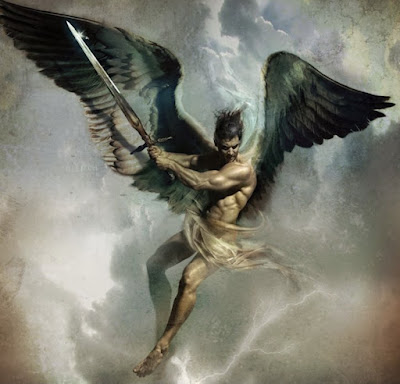
Maori traditionally used dried heads of enemies to raise war-parties. After the ambush and slaughter of troopers by Hauhau at Ahuahu on 6 April 1864 (see my post  “How Captain Lloyd Lost his Head” below) their heads were cut off on the spot and later dried as trophies - according to Maori custom. The Hauhau were an aggressive development of the original teachings of the Maori prophet Te Ua who founded the peaceful Pai Maririe religion in Taranaki in 1862. Shortly after Ahuahu Te Ua revealed that he had been visited (again) by the Angel Gabriel - whose instructions were that Captain Lloyd’s head was to be carried as a victorious religious tropy throughout the North Island in a stirring (but peaceful) recruiting drive to draw Maori to the Pai Maririe cause: which was basically an attempt to stop the loss of tribal lands to predatory carpet-baggers and land-sharks from Britain. Below; the Angel Gabriel: However, the militant emissaries entrusted with this task instead saw their role a...
Slaughter of Hauhau at Sentry Hill

Image
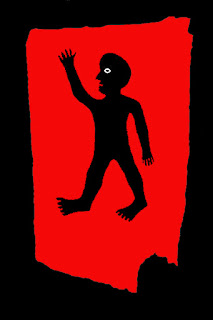
Despite their magical chants and signs attacking Hauhau warriors were cut down in a hail of bullets. When fanatical Hauhau warriors stormed the British redoubt at Sentry Hill (east of New Plymouth) on the morning of 30 April 1864 they were confident that their magical hand-signs and chants would protect them from the Pakeha bullets. Below: Hauhau flag with figure making the upraised had (ringatu) gesture to ward off bullets. Soldiers in the small fort watched in amazement as over 200 armed Maori marched fearlessly toward them across mostly open country, lead by chiefs including Te Whiti and Tohu Kakahi (afterwards the prophets of Parihaka). With their right hands uplifted and chanting  “Hapa, hapa, hapa! Hau, hau, hau! Pai-marire, rire, rire—hau!” the warriors marched up the small hill. Equally confident in their fire-power the 75 well-armed troops of the 57th Regiment held their nerve until the zealots came within metres. Unfortunately for the Maori their incantations and gestures...

Pokeno Waikato War Memorial

Image
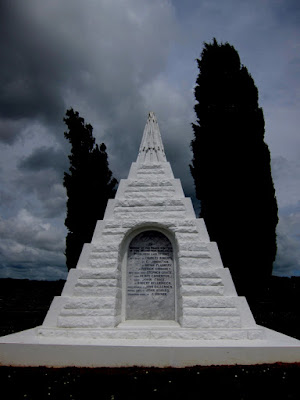
Unusual Waikato War memorial       The land around Pokeno is rapidly disappearing under hideous tract housing. Other than this construction here is very little in this area to signify the momentous occasion when Imperial troops invaded the Waikato at the command of Governor Grey.       On 12 July 1863 British troops crossed the Mangatawhiri River (just south of Pokeno). This river marked the aukati (boundary) line between the Auckland district and the “King Country” - the heartland of the Waikato under the mana (protection) of the Maori King, and its crossing was therefore regarded as a declaration of war.       From: “The New Zealand Wars” - Philippa Werry p.28       The Pokeno memorial was not erected until 1902, and only commemorates the Europeans who fell. “Rather than a simple obelisk or stone cross, stonemason John Bouskill created an unusual pyramid, topped with a cluster ...

Commemorative Figures for Te Kooti

Image
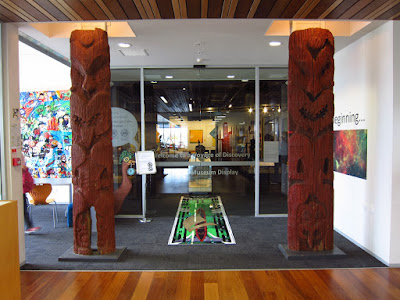
 Carved figures commemorate Te Kooti's pardon.       In 1883 Ngati Pukeko of the Eastern Bay of Plenty, constructed a meeting house (Awanuiarangi) which they presented to Te Kooti to commemorate his pardon by the government. These carved figures are from that meeting house - today they can be seen in the foyer of the Whakatane library.

Te Kooti’s Murderous Raid on Whakatane

Image
Innocents slaughtered as Te Kooti raids Whakatane  district for supplies and weaponry.       In “Frontier” Gavin Maxwell says that in March 1869, two months after his disaster at Ngatapa, Te Kooti “sought to reinforce and re-arm his followers...to swell their ranks with recruits from the Tuhoe” of the Whakatane area. p.262 Judith Binney’s view is:” “Success would breed success...and those who wavered out of fear would be driven to join him.” p.156 "Redemption Songs"       And so the Ringatu descended from their mountain fastness of the Urewera and cruelly smote the peaceful settlements on the plain. The ensuing slaughter of Maori innocents “reinforced the bitter resentment of him among Maori, and ensured that their pursuit of him would be relentless. One of the principal reasons behind Te Kooti’s fall was that he would not, or could not, call a halt to the slaughter of his own people.” Maxwell p.262    ...

Captain Travers Looses His Head to Te Kooti

Image
Captain Traver’s impaled skull was identified by his gold teeth.       The Tuhoe tribes were a fierce warlike people whose proud boast “'Tuhoe moumou taonga, moumou tangata ki te Po” (“Tuhoe, the destroyer of earth’s treasures and the master of mankind unto death”) resulted in the bones of their warriors finding a resting place on many battlefields, while their heavily forested and rugged mountainous fastness in the Urewera saved them from them from disastrous invasion for centuries.       However, after they sheltered Te Kooti and his Ringatu followers, the Tuhoe experienced the full vengance of the Crown in 1869 - their crops were burnt, their stock killed and their villages destroyed. Even worse, much of their land was later confiscated.       As part of this scorched earth policy government troops attacked the strongly fortified pa of Tatahoata, at Ruatahua, May 1869. During the engagement, Capt...

Rotorua’s Stone Warriors

Image
Invading army turned to stone by tohungas.       Long before the Maori arrived from Hawaiki the Rotorua district was occupied by Patupaiarehe: an elf-like race of people, with very fair skins. They were very skilled in the arts of magic and extremely wary of strangers.       Mount Ngongotaha, beside Lake Rotorua, was sacred to them as a guardian - and from its heights they could keep watch across the countryside in every direction.       Ominously, one day the birds fell silent and the sunlight turned a peculiar hazy colour as if affected by a large forest fire. As the concerned lookouts scanned the land below they saw the treetops covering the Mamakau Plateau to the north begin to toss furiously as if blown by a hurricane, yet the air on the mountain was still. Tremendous thunderclouds gathered and the earth began to shake.       The Patupaiarehe realized that they were being ap...

Kuirau and the Taniwha

Image
The gods were so angry they made the water boil.       At Kuirau Park in Rotorua can be found a remarkable assortment of steaming thermal activity, including a large extremely hot pool amidst tea-tree and swirls of steam - Kuirau Pool - named after a Maori woman who had a most unfortunate experience with a taniwha (water-monster).       Long before the coming of the white man the pool was known as Tawakahu. At that time its temperature was perfect for bathing, and successive chiefs reserved the water for the use of themselves and their families. Possession of the pool eventually passed to Tamahika who reserved the waters for the private use his very beautiful young wife Kuirau.       Kuirau swam naked in the comforting waters every morning and evening, unseen by human eyes. However she was constantly watched from the deep bottom of the pool by a vicious taniwha. This evil monster was afraid of man only em...

Maori Chief Rejects Portrait

Image
 “No! It’s no good, and I’m not paying for it!”        In old New Zealand, before the Treaty, there were many people from Britain and Europe who washed up on these shores for one reason or another. One of them was a rather pedestrian oil-painter from Poland who went around the country painting commissioned portraits and landscapes to make ends meet.        While up in the far north he persuaded a very dignified and elderly Maori chief to have his portrait painted. As the artist was obviously in straightened circumstances, the chief was able to bargain the fee down to five guineas.         The chief sat still for several days in the local pub while the artist worked busily with brushes and paint. At last the work was finished and the chief was invited to look upon his likeness. He picked up the canvas and examined it for some time with a critical eye before pronouncing “No! It’s ...

Tattooed Hauhau Warrior Killed

Image
Body repeatedly exhumed so Maori could examine his colourful Marquesian-style tattooing.         After his murderous attacks on Gisborne, Whakatane and Mohaka Te Kooti was very much a wanted man - by now he had a price of a thousand pounds on his head. After his disasterous defeat at Ngatapa at the end of 1868 Te Kooti had retreated into the wilderness of the Urewera to be sheltered and supported by Tuhoe.         From mid-April 1869 the Government launched a three-pronged search-and-destroy mission into Tuhoe territory: with the aim of searching for Te Kooti, while relentlessly destroying Tuhoe crops, stock and villages in order to turn them against the Ringatu leader.        On 8 May the force, under Colonel Whitmore, attacked the strongly fortified pa of Tatahoata at Ruatahuna in the heart of the Urewera. While the firing raged, Captain Travers strode up and down directing ...

Infidelity Causes Suicide

Image
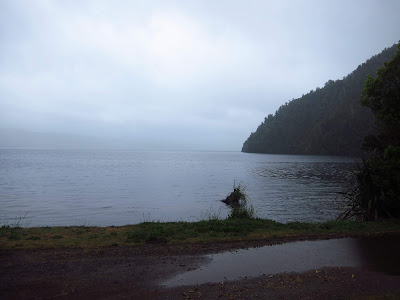
On Lake Rotoiti “The Leaping Place of Tikawe” gets its name from an incident when a Maori woman leapt to her death after being jilted by her husband. Lake Rotoiti near The Leaping Place of Tikawe              In days long past Tikawe, a high-born woman, lived at Te Taiki pa on a high cliff-top beside Lake Rotoiti with her husband whom she loved dearly. Historian James Cowan relates that one day Tikawe’s husband went away to the east, while she anxiously awaited his return. But as weeks turned into months she grew more worried every day, becoming increasingly emaciated and listless. One day a visitor from Heretaunga (Napier) arrived at Te Taiki with the news that Tikawe's husband had fallen in love with a woman there and had settled down with her. There was much concern on the marae at the way Tikawe had been deserted, with some wanting to raise a war party to punish the adulterer at once. Tikawe did not join the people but...

Rewi’s Last Stand

Image
Despite facing overwhelming odds in a hastily constructed gunfighter pa at Orakau in 1864 besieged Maori defiantly declared that they would never surrender. The last battle of the Waikato War saw Maori warriors, as well as women and children, led by Rewi Maniapoto trapped in a poorly prepared defensive position - running out of food, water and ammunition while facing odds of 16 to one. Despite this, when offered a chance to surrender, they swore that they would fight “for ever and ever”.  However, shortly afterwards the majority of the defenders fled the pa from the un-besieged rear, running south towards the Punui River. A British cavalry charge and gunfire killed many of them. Rewi Maniapoto survived to continue his resistance to the taking of Maori land for many years, in conjunction with the Maori King, but this was the last time he stood and fought militarily.   Cavalry charge the defenders FURTHER READING: “The New Zealand Wars” - James Belich, p....